What tools do I need to start a business? This article outlines some quick, easy, and free tools to help you start your business. Rather than being overwhelmed by the options out there, use these simple tools and get focused on the one thing that matters, actually starting the business!
These beginner level tools are perfect for you to get started. They are easy to set up, easy to navigate and learn, and you can quickly build what you need to get back to focus on the main business.
Productivity and project management tools.
If you Google ‘productivity and project management tools for startups,’ you’ll see a myriad of different productivity and project management tools like Trello and Asana. ‘Use this app to save 1.5 hours a day’, or ‘use this tool to hack your productivity’, they say.
That is all great for later down the line, but if you’re just starting your business. I would recommend the simple, free route.
These would be Google Sheets and Google Docs. Sign up for a google account right away, and you will immediately have access to these tools. You literally can get them set up in under 5 minutes.

Google sheets can be an excellent project and productivity tracker. You can build a simple spreadsheet, or download a template off of google to perfectly manage a multi-faceted project. But at this stage, you likely just need something simple, and Google Docs / Goole Sheets can just do that.
My first meeting agendas for my business were all in Google Sheets, and they still are today! My first project lists were in Google Docs, and again, I still use that tool today to easily track many different projects.
The next free tools for productivity and project management are Google Calendar and a handy notepad (that should always live on your desk). With a little creativity and proper planning, these 2 tools can help you manage all of your daily productivity and tasks.

How do I use Google Calendar and Sheets?
Whenever I think of a new task or part of the project, I immediate Google Calendar. Right then and there. I don’t need to think about it until later when it is time to make the work happen. I know I have it down, whether on my laptop or phone, and I will get back to it. With juggling everything you need to start a small business, the last thing I need is to be constantly forgetting tasks. Even waiting 2 minutes might mean I forget that task until it is too late!
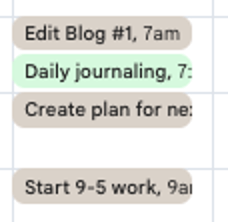
In this sample, I have a few tasks that I wrote down the day before, so I know I can get up, tackle them, and move on!
Each week, I organize all of the tasks on my google calendar for the upcoming week. That helps me identify how much time the task will take and what I need to do each day of the week. I can break down every day into discrete 15-30 minute tasks, or even block off longer if I need to (even though I am not so productive past about 45 minutes of continuous work). The calendar screenshot above shows that. Small, discrete tasks keep my days productive.
Specifically I add each item to the calendar and the default color of grey (which I changed to be the default) and then when I completed the item I manually change the item to a dark green. That gives the satisfaction of completing the task and also lets me know I don’t need to look at those items again.
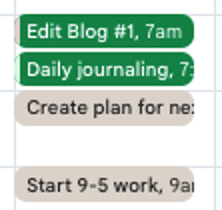
You can get fancy with it like I did above by having some blocks be different colors – e.g. the light green is for ‘personal’ tasks not related to work or business. But that can come later.
With this strategy, you will also a permanently referenceable file in my Google Calendar of all the tasks that I’ve completed. You can keep track of every business project and task, and personally, I love the look of the dark green showing that I’ve had a productive day. That inspires me to have a productive next day, and the next day, and I can look back upon a successful week.
To supplement this calendar, I also have my handy notepad that lives at my desk. It does not move, ever!
The items I jot down here are smaller or personal items, like taking out the trash, or doing laundry. I physically remove that item from my mind and onto the paper. I will get back to it later! Work and business live on the google calendar.
Financial Management Tools
Start with Google Sheets. There are many, many, tools out there. But if you are just starting, Google Sheets is the simplest, best way to do it.
Take a look at this sheet for example. Want to manage a budget? Forecast revenue?
Start by making a tab for the specific year. You can make each column a month, and each row a different type of expense.
When you’re just starting out you shouldn’t have too many different categories of expenses so this should be sufficient to start your business. Again, the focus is on starting and not overwhelming yourself with all the tools you might need.
Marketing and Design Tools
The greatest tools to start marketing your business are on Canva and Google sheets. I like the free version of Canva because it offers an immense amount of customization and tools that you could use to design a quick logo or marketing materials. They even have a new AI feature that allows users to plug in a request for AI which will generate the image for you!

If you’re overwhelmed by the need for “marketing” this may be an area where you focus some of your budget. If you’re spending too much time on a logo or colors, and that isn’t your expertise, maybe you should look to friends, or have someone help make a quick logo for you (Fiverr or Upwork provide good, inexpensive options).
You can also head to Coolors.co for a quick color palette generator.

This initial marketing can be an extreme distraction if you focus too much time on it unnecessarily. Again the logo and colors can be changed in the future and these free tools give you a great enough start!
Communication and Collaboration
Gmail and the free version of zoom should provide you all you need to start the business. Ideally you shouldn’t have to pay for any communication or collaboration tools at this point as the Google suite provides live working documents that you can work on with teammates.
Canva also provides A-Team version if you would like to update or upgrade in order to collaborate in live time with teammates.

What tools should you look into next? 5. Analytics and Data Tracking Tools
What tools are next? Now that you have the basic tools you need to actually get the business off the ground, you can focus on your business itself. Spend some time on that. Use these tools for a week and get your business launched. Next you can focus on analytics, data tracking, and integrating more complex tools as your business grows!
This article provides a brief overview of the simple, easy, and free tools to help you start your business.
 Startup Feature
Leave a comment